From scattered content reviews to a governed AI workflow.
How Eve Wealth connected marketing, lifecycle, product, design, and legal around one operating layer, cutting content production time by 60% while keeping human judgment in control.
The team was moving quickly. The review system wasn’t.
Eve Wealth’s marketing, lifecycle, product, design, and legal work was deeply connected, but the context needed to move that work forward lived across Notion pages, documents, Slack threads, campaign conversations, and individual memory.
Creating a single piece of content could involve three people and three or four rounds of review. Legal language was difficult to trace, approval status was not always visible, and each new campaign required the team to reconstruct context that already existed somewhere else.
The problem wasn’t a lack of expertise. It was that the expertise had no shared operating layer.
More chasing. More risk. No dependable source of truth.
- Briefs began in separate documents
- Source material lived in Slack and past campaigns
- AI drafts were created without complete business context
- Feedback and revisions moved through direct messages
- Legal language and approval history were hard to trace
- Ownership and launch status were not visible in one place
Structure the work before accelerating it.
Keel did not begin by adding another AI tool. We first designed the operating logic underneath the work: where approved context lived, how a brief became a draft, who reviewed what, when legal entered the process, and what needed to be preserved after publication.
Once those rules were visible, AI could support the work without bypassing the people accountable for it.
Operating layer
Campaigns, timelines, owners, launch status, meeting decisions, and next steps connected in Notion.
Trusted knowledge
Approved source language, legal guidance, disclaimers, previous decisions, and reusable campaign context organized for retrieval.
Governed AI workflow
AI assisted with drafting, while expert review, legal sign-off, and final human approval remained explicit steps.
Ownership made visible
Every project carried named responsibility, so cross-functional work no longer depended on memory or a Slack thread to explain who decided what.
Knowledge that could be reused
Approved language, disclaimers, and prior legal decisions were structured for retrieval instead of being rebuilt for each campaign.
One operating layer for content, lifecycle, and compliance.
Marketing and lifecycle hub
A shared place for campaigns, content, timelines, owners, status, and launch notes.
Compliance hub and legal library
Approved language, disclaimers, legal assets, review status, ownership, and approval history organized in one system.
Connected cross-functional workflow
Marketing, lifecycle, product, design, and legal could see the same work without relying on separate status updates.
Reusable context
Past decisions and approved source material became reusable inputs rather than context the team had to recreate.
Governance rules
Clear definitions for what AI could draft, what required subject-matter review, and what could never publish without human approval.
Notion · Customer.io · Zapier · Typeform
From scattered review to a system the team could trust.
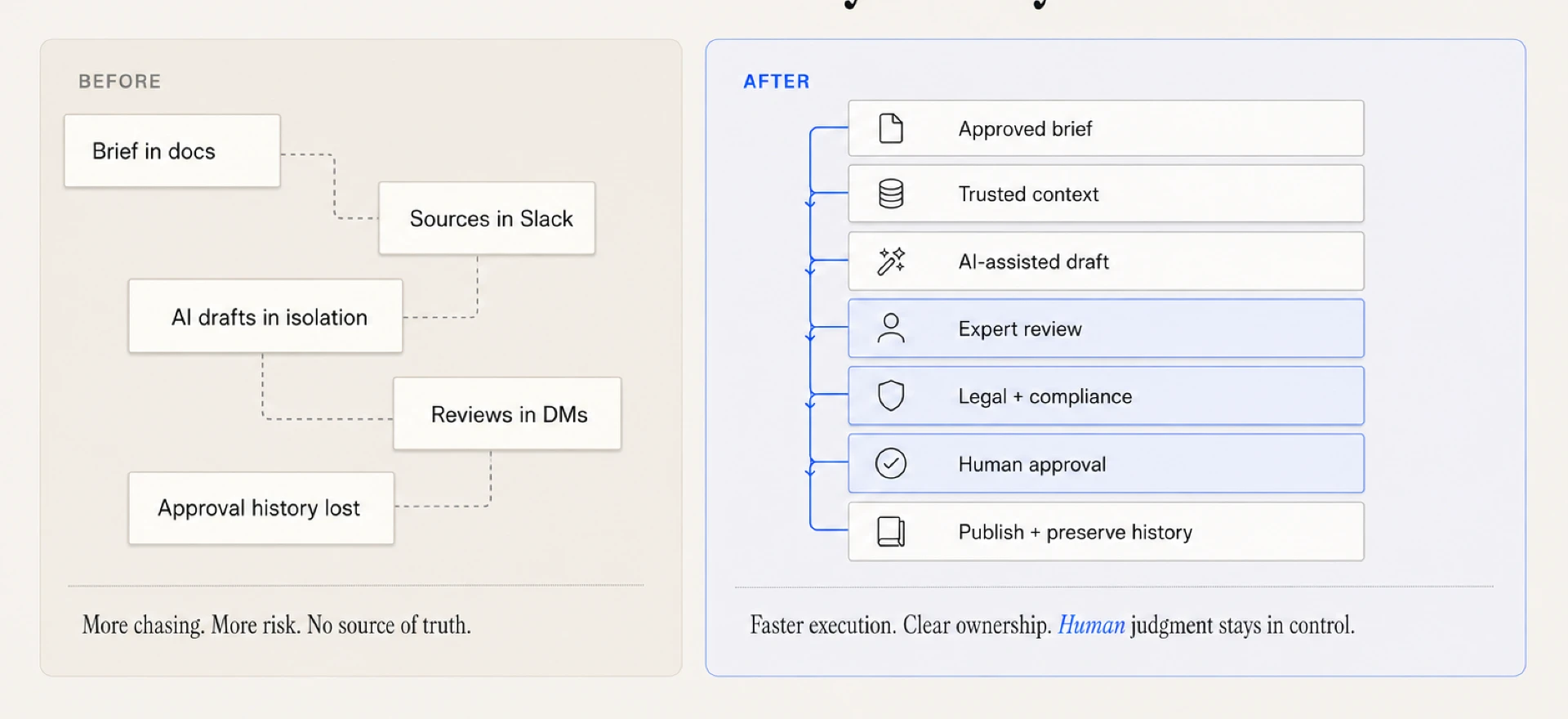
How the workflow worked.
- 01
Approved brief
The assignment, objective, audience, owner, and requirements were made explicit.
- 02
Trusted context
AI worked from approved source material, campaign history, and legal guidance.
- 03
AI-assisted draft
The first draft was accelerated without treating the output as final.
- 04
Expert review
The responsible subject-matter owner reviewed accuracy, positioning, and nuance.
- 05
Legal and compliance
Required language, claims, and disclaimers were reviewed by the appropriate stakeholder.
- 06
Human approval
A named person remained accountable for the final decision.
- 07
Publish and preserve history
The final asset, approval status, and reusable decisions remained in the system.
AI could move the work forward. It could not approve itself.
Every AI-assisted asset moved through defined review points. Legal retained control over compliance decisions, subject-matter experts retained control over accuracy, and a human remained accountable for what went live.
Human judgment was not a workaround. It was part of the architecture.
Faster execution without trading away trust.
The new system reduced content production time by 60% and increased cross-team execution speed by 40%. Work that previously involved three people and three or four rounds of review could often be completed by one person with mostly one-pass approval.
The deeper shift was organizational. The team no longer had to choose between speed and control: approved context, review ownership, and decision history were built into the same workflow.
- Faster first drafts using trusted context
- Fewer review loops and status-chasing messages
- Clearer legal ownership and approval history
- One visible source of truth across functions
The AI layer succeeded because the operating layer came first.
The team did not need a more powerful drafting tool. It needed a clear system for context, ownership, review, and decisions. Once that foundation existed, AI could contribute inside the workflow instead of operating beside it.
Make the work ready before you make the AI powerful.
Where is your team still rebuilding context by hand?
We’ll map the workflow, identify what should stay human, and show you what needs to be structured before AI can safely accelerate it.